SCHOOL KWANZA

Online learning &e-learning platform for study resources for students and teachers

LEARN HOW WE WORK

LightBlog

Breaking

Monday, April 13, 2020

April 13, 2020

HIV and AIDS


Relationship Between HIV, AIDS and STIs Defference between HIV, AIDS and STIs Distinguish between HIV, AIDS and STIs HIV/AIDS (Human Immunodeficiency Virus and Acquired Immune Deficiency Syndrome) Acquired means “to get from” this means that AIDS is gotten from other people, “Immune” means “protect”, this means that the body is normally protected against many diseases. Deficiency means “lack: and syndrome means a group of different symptoms of diseases. AIDS is the pandemic disease, which is caused by a certain type of organism called virus. These types of viruses are called Human Immunodeficiency Virus. The Human Immunodeficiency Virus destroys the Immune system, destruction of the immune system makes it easy for the body to be attacked by other diseases. It takes a long time for HIV to damage the immune system. It takes years before the body’s immune system is destroyed. That is why some people may have HIV in their bodies but not look or feel sick yet. We call these people HIV carriers because they carry the virus in their bodies. When HIV carriers finally begin to show the sign and symptoms of AIDS then we say they have AIDS. STDS and STIs (Sexually Transmitted Diseases and Sexually Transmitted Infections) STDs and STIs are diseases and infections, which are transmitted through sexual intercourse. Examples of diseases and infections are: gonorrhea, syphilis, trichomoniasis, candidiasis, chlamadia, genital herpes and hepatitis B. The Relationship between HIV and STIs Explain the relationship between HIV and STIs The link between HIV and other STIs might seem obvious. After all, the same sorts of risk behaviour are involved. However, numerous studies seem to indicate that there is a stronger association between HIV and other STIs than would be expected simply from a behavioural link. Infection with STIs (including syphilis, gonorrhoea and herpes) seems to increase the risk of both acquiring and transmitting HIV over and above a behavioural link. So does bacterial vaginosis, a condition not formally classed as an STI, since it appears not to be transmitted, but which is associated with poor sexual health generally. Depending on the STI involved and the population, studies have reported that having an STI magnifies the risk of acquiring HIV by anything from two to eight times or more. In the case of people with HIV, having an STI increases viral loads both in the blood and genital secretions, thus making people more infectious – even when taking antiretroviral treatment. Transmission of HIV/AIDS HIV can be transmitted by: Sexual intercourse with infected person Blood Transfusion from an infected person Organ transplant from an infected donor An infected mother to her child during pregnancy, birth or breastfeeding Using unsterilized surgical instrument e.g. scalpel, needles etc Sharing toothbrushes, sharing blades, nail cutter with infected person Symptoms and Signs of HIV/AIDS The following are symptoms of HIV/AIDS Loss of weight Persistent fever that lasts longer than a month Diarrhea Coughing for more that a month Itchy rashes on the skin White layer in the mouth and throat Swollen gland especially in the neck and armpit Genital rashes Shortened breath Effects of HIV/AIDS People with AIDS get opportunistic infections and diseases, example of these infections and diseases are: Chest infection such as pneumonia and Tuberculosis (TB) Brain infection leading to mental confusion Sever headaches and fits (seizures) Stomach infection leading to diarrhea lasts for weeks Skin cancer known as carposis sarcoma Management and Control of HIV/AIDS and STIs Ways of managing and controlling HIV, AIDS and STIs Outline ways of managing and controlling HIV, AIDS and STIs Prevention and Control Measures include: Avoid irresponsible sexual behavior. Follow ABC guide: Abstain from sexual intercourse. This is the best method of prevention for the unmarried people Be faithful to one sexual partner Use Condom during sexual intercourse Use sterilized instruments during surgery, circumcision and delivery Wear disposable gloves when you touch other people’s bodily fluids Only screened blood and organs should be used for transfusion and transplants Go for HIV and AIDS test in order to know your status Do not share toothbrushes and blades People with HIV and AIDS should be given anti retroviral drugs (ARVs) which help to slow down the progression of the diseases in the body Pregnant women should attend pre-natal clinic where they can be treated to prevent mother to child transmission HIV positive mothers should not breastfeed their newborn babies The Life Skills Needed for Home based Care for PLWHA Mention the life skills needed for home based care for PLWHA People with HIV and AIDS can live healthy lives for a longtime if they get proper care and support. We can care for them and support them in the following ways: Giving them well-balanced meals in adequate quantities Allowing them to rest when they feel unwell Taking them to a health center as soon as they start developing signs of illness Providing them with ARVs which help to slow down the advancement of the condition Allowing them to work and exercise if the can Behaving in a loving way toward them Listening to them and helping them when they have a problem Counseling them to stop behaviors that could worsen their condition. Example: taking drugs or having many sexual partners Not discriminating against them or stigmatizing them by doing the following: Branding them names such as “walking corpse”; Denying them education or health services; Denying them work opportunity; Chasing them away from home; Refusing to share utensils or room with them; Not involving them in decision-making processes; Hiding them from the public. Keeping their bodies, clothing and bedding clean Precautions to be taken when Handling People Living with HIV/AIDS (PLWHA) and STIs Mention precautions to be taken when handling people living with HIV/AIDS (PLWHA) and STIs Carers will have their own concerns and worries, fears for the future, for their families and for their own health. It is important that they take care of themselves, get enough rest and have the appropriate information and support to carry out their difficult task. The important messages given below cannot be emphasized enough. HIV/AIDS is not spread by food or water. HIV/AIDS cannot be spread by sharing food, dishes or cooking utensils such as cups, plates, knives and forks with a person who is HIV positive. HIV/AIDS cannot be spread by touching another person, hugging, shaking hands or holding other people in a normal way. There is no need to avoid body contact with a person living with HIV/AIDS. Counseling and Voluntary Testing (CVT) The concept of Counselling and Voluntary Testing Explain the concept of counselling and voluntary testing Counselling and voluntary test is the process that is undertaken when a person wants to find out if she/he is affected with HIV. Because it is voluntary, a person who think they might have HIV decide on their own whether they want to have the test done or not. If the individual decided to go ahead with testing they will have the opportunity to discuss the test with a trained counselor. Most clinics use rapid accurate scientific tests that make the result available, usually within twenty minutes after the test has been performed. Voluntary counseling and testing (VCT) for HIV is an efficient internationally recognized approach for people to find out their HIV status at a VCT center. VCT has become one of the most effective and popular ways of diagnosing people who may have been exposed to the virus or who have been infected. The Significance of CVT in the Control and Prevention of HIV/AIDS and STIs Outline the significance of CVT in the control and prevention of HIV/AIDS and STIs VCT is an important tool for preventing the spread of HIV especially in communities where the epidemic is widespread. The following are the importance of counseling voluntary test: It allows adolescents to find out their own HIV status in order to evaluate their behavior and its consequences. VCT clinics usually have 45 minutes counseling sessions that provide information about HIV and AIDS and testing process VCT can help improve advocacy and reduce stigma by giving people the opportunity to talk anonymously and confidentially with a counselor about their HIV status The Procedures and Techniques of CVT for HIV/AID Explain the procedures and techniques of CVT for HIV/AIDS There are three main steps in VCT, as explained below: First Step: There is a session of pre-test counseling where questions about HIV/AIDS and the test are discussed and answered by the counselor. The counselor will help the individual determine whether testing is appropriate given the information that is shared with them about the reason the individual wanted to be tested. Sharing information about their past sexual behaviors will help the counselor determine whether testing is appropriate. After making their assessment, if the counselor deems it appropriate for the person to take the test they should: Describe the test and how it is performed Explain AIDS and the way infection is spread Discuss the ways to prevent the spread of HIV/AIDS Explain the confidentiality of the test results Discuss the meaning of the possible test results Ask what impact you think the result of the test will have on them Discuss whom they might share their results with Discuss the importance of telling their sex partners and/or drug using partners if the result are positive Second Step: When the person decided to have the HIV test they must sign a consent form before the test is administered. Informed consent is the crucial part of the VCT process and it is important that the individual is aware of their right to refuse any medical procedure, to be informed about it and to agree to it. There is a statement which they should be asked to read beforehand stating that they have been informed about the HIV-antibody test procedure, that they understand and have given their consent to have the test performed. Third Step: After the test has been done, the counselor gives the results to the person in the post-test counseling session. (It usually takes around fifteen to twenty minutes after the test has been administered for the results to be ready). If they are found to be HIV positive (meaning that they have HIV) then they are referred to a medical specialist and other counselor in order to aid them in receiving treatment and support.

Thursday, January 24, 2019

January 24, 2019

QUALITATIVE ANALYSIS-Form FOUR

The Meaning of Qualitative Analysis
Explain the meaning of qualitative analysis
Qualitative analysis involves determining metals and non metals (or metallic and non-metallic elements) present in a given sample. It is a process used to determine what elements (or radicals) are present in the sample.
Whereas quantitative analysis involves determining how much (quantity) of a substance is present in a sample, qualitative analysis involves identifying what (quality) substances are present in a sample.
Qualitative analysis may be divided into examination of:
  • acidic or non-metallic radicals or negative ions;
  • basic or metallic radicals, including ammonium ion.
The Importance of Qualitative Analysis in Real Life
State the importance of qualitative analysis in real life
Qualitative analysis has numerous applications. The following are some applications (importance) of qualitative analysis in real life.
Detection of poisonous substances in the environment
Sometimes it may be necessary to find out the chemical composition of contaminants in the environment. This may require the application of qualitative analysis procedures to identify the chemical composition of a given contaminant. Qualitative analysis methods are highly employed by environmental scientists to detect and identify different contaminants in the environment.
Determination of ions present in a chemical substance
This is achieved through dissolution of a substance in distilled water. Then the characteristics of the solution formed serve as a clue to establish the type of elements present in a tested sample. The mixture formed following dissolution of a solid sample may be a clear solution, an emulsion or a precipitate. The solution or emulsion is further analysed to detect the ions present in it. The precipitate is then separated from the filtrate and both are subjected to further tests to identify the kind of elements present.
Determination of the type of gases produced in a chemical reaction
Many chemical reactions are accompanied with evolution of gases, as one of the products of the reaction. In some cases, the smell of the gas may not suffice to detect the gas, especially if the gas is colourless and odourless. In such cases, the gas is subjected to various qualitative analysis tests in order to establish its identify.
Finding the nature and identity of chemical substances
The nature of a chemical substance such as its solubility in water, characteristic smell, flame colour, and the characteristics of its reaction products can be used to identify the chemical substance under test. In this way, the nature and identity of unknown substance can ultimately be known.
Soil analysis
Determination of soil pH
Soils of given pH give specific colours when their solutions are added to certain types of indicators. This procedure is purely qualitative because it involves observation of the change in colour of indicators to determine the pH of the soil. For further details on the measurement of soil pH, read a topic on Soil Chemistry (Chapter Three) in this book.
Determination of soil composition
Qualitative tests are performed to determine the type of minerals contained in a particular soil. Such tests include test for nitrate, sulphate, chloride and phosphate ions. Determination of soil composition gives soil scientists information necessary for conservation.
Application in medical and criminology fields
Qualitative analysis techniques are applied in medical field, for example in carrying out various tests such as testing blood and urine samples, determining the level of blood sugar, pregnancy diagnose and blood grouping. Most of these analytical tests are done to diagnose a wide range of diseases and medical conditions.
For example:
  • in detecting the causative agents for typhoid (salmonella typhi), the blood is left to clot, or it is centrifuged in order to separate blood corpuscles from plasma. The plasma is then subjected to various qualitative tests to detect the presence of salmonella typhi.
  • in pregnancy diagnosis, a certain chemical is added to urine, where a specific change in colour of the urine confirms whether one is pregnant or not.
Qualitative analysis is also applied in blood grouping, whereby antibodies are added to the blood to determine the blood group. Agglutination of the blood corpuscles when antibodies are added help detect the group of the blood.
Forensic scientists may use qualitative chemical analysis to identify substances left at crime scenes, which can be vital in convicting criminals.
Application in industries
Many industries use qualitative analysis in their efforts to perform better and make quality products.In chemical industries, the products often get contaminated by unknown contaminants. Qualitative tests are done to detect the contaminants. This may be followed by quantitative analysis aiming at finding out the quantity (amount) of the contaminant present.
Qualitative analysis techniques
It is very important to be very keen when performing qualitative analysis tests. Just a small error can cause misinterpretation of the contents of a tested sample. The following are few but important measures that should be observed when carrying out qualitative analysis experiments.
Adding the reagent
After adding the test reagent, make sure the solution is stirred thoroughly. Before making any inference, wait until the solution has completely settled down. Often, additional quantities of the reagent must then be added so that an excess is present.
Avoid contamination
Contamination of the sample or reagent should strictly be avoided. For instance, if the contaminant contains a cation, the test can give misleading positive results. To avoid contamination of the sample and apparatus, the following precautions should be observed:
  1. All the apparatus should be cleaned and dried thoroughly and must remain clean throughout the experiment.
  2. Do not lay a glass rod on a dirt laboratory bench as it can get contaminated easily.
  3. Avoid touching the side of a test-tube with the tip of a dropper. The contaminant can be picked up and transferred to another solution, a fact that would contaminate the solution, thus producing false results.
  4. Only distilled water from the wash bottle should be used to dissolve the solids. Spring, rain or tap water contains chemicals that can lead to wrong results and conclusions.
Warming up the solution
The solution is warmed by dipping the test-tube containing the solution in a beaker of warm or boiling water (water bath). The test-tube is kept in a water bath for some time, with constant stirring. Then, the solution is tested for the presence of anions or cations contained in it.
Testing the pH of a solution
This is conducted by placing a litmus paper on a clean, dry surface and then pouring a drop of the solution to be tested on it. The colour of the paper is observed and noted while the paper is wet. Once dry, the colour may change or disappear, resulting in wrong interpretation.
The procedures of qualitative analysis involve carrying out analytical tests in the appropriate sequence of steps. The common procedures for testing an unknown sample is to make its solution and then test this solution for different ions present. The steps involved in the systemic analysis of a given sample are as follows:
Preliminary tests
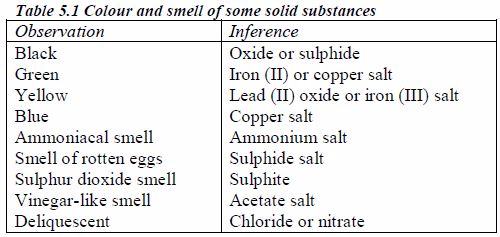
  • Colour and smell
  • Flame test
  • Solubility in water
  • Dry heating
  • Action on litmus (for gases evolved)
Tests for acid radicals (anions)
  • Dilute acid test (dilute H2SO4)
  • Concentrated acid test (concentrated H2SO4)
  • Wet test for acid radicals

Preliminary Test on an Unknown Sample
Carry out preliminary test on an unknown sample
Preliminary tests include noting the appearance (colour, texture, feel, etc) of the sample, detecting the smell of the gas liberated, observing the action of a substance on litmus, and even the taste of the substance under investigation. The preliminary tests give a clue about the type of the elements present in a sample.)
g1_1449380513741
Table 5.2 Identification of gases
GasColourSmellAction on litmusTest
CH3COOHColourlessVinegar-likeAcidicLiberated as dense white fumes
N2ColourlessOdourlessNeutralNo chemical test
Water vapourColourlessOdourlessNeutralTurns white CuSO4 blue
NO2Reddish-brownPungentAcidicNot as red as Br2 vapour and does not condense on the sides of the test tube
NH3ColourlessPungentAlkalineForms thick white fumes when in contact with HCl gas
HClWhite fumesIrritatingAcidicForms thick white fumes when in contact with NH3 gas
HBr & Br2White fumes & reddish- brown gasChokingAcidic & bleachesHBr resembles HCl, & Br2, condenses to a red liquid on the sides of the test tube
Cl2Pale greenBleachesChokingGives white fumes with NH4OH
I2VioletChokingBleachesTurns starch iodide paper blue-black
CO2ColourlessOdourlessSlightly acidicTurns lime water milky
COColourlessOdourlessNeutralBurns with pale blue flame
H2ColourlessOdourlessNeutralBurns with a „pop‟ sound
H2SColourlessRotten eggsAcidicBurns with blue flame to SO2, blackens lead acetate paper.
O2ColourlessOdourlessNeutralRe-ignites a glowing splint
SO2ColourlessIrritating smell of burning sulphurAcidicDecolourizes KMnO4 solution, turns K2Cr2O7 from orange to green
SO3ColourlessPungentAcidicFumes in moist air forming dense white fumes
Colours of some ions in solution
The appearance of a substance in solid or solution form can help in its identification:
  • If a compound and its solution in water are colourless, it is probable that a transition metal is absent.
  • If its colour is black, it is probably an oxide or a sulphide.
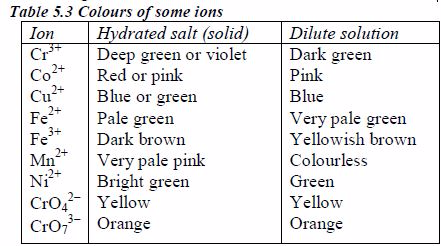
  • If the solid and its solution in water are coloured, probably a transition metal is present.
The following are the colours of some transition element ions
g1_1449398134540
g1_1449398242930
g1_1449398338246

Preparation of Stock Solutions from Soluble and Insoluble Salts
Prepare stock solutions from soluble and insoluble salts
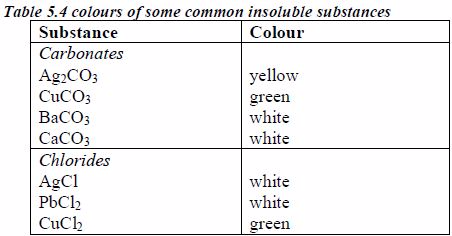
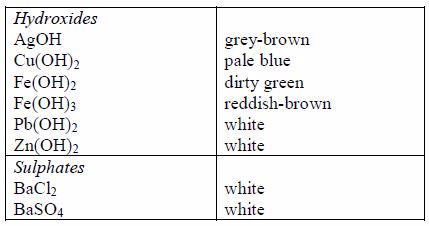
The solubilities of different compounds in water can be used in their identification. It is therefore important to know the solubilities of different compounds
To test the solubility of a compound, put one spatula of the compound in 1 cm3 of distilled water and stir. If the compound is soluble, this amount will dissolve. If the compound is moderately soluble, some of this amount will dissolve. If the compound is insoluble, not even a small amount will dissolve.
The following are some general rules on the solubility of different compounds in water:
  • All common nitrates of metals are soluble.
  • All common sodium, potassium and ammonium salts are soluble.
  • All common chlorides are soluble except those of silver, mercury (I) and lead (II).
  • All common sulphates are soluble except those of lead and barium. The sulphates of calcium and silver are sparingly soluble.
  • All carbonates, sulphites and phosphates of sodium, potassium, and ammonium are soluble but other common carbonates are insoluble.
  • Sodium, potassium and ammonium hydroxides [(ammonia solution, NH3(aq)]* are soluble but other common hydroxides are insoluble.
  • All sulphides are insoluble except those of the alkali metals, the alkaline earth metals and ammonium.
* It is important to note that ammonium hydroxide does not exist. The solution of ammonia in water (ammonia solution) is always wrongly termed as ammonium hydroxide. Although the name ammonium hydroxide suggests an alkali with the formula [NH4+][OH–], it is actually impossible to isolate samples of NH4+ and OH– ions from a solution of ammonia in water since the ions are negligibly very few in solution except in extremely dilute solutions.
Action of heat on the original substance
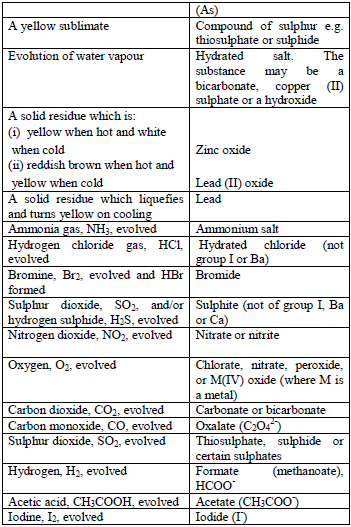
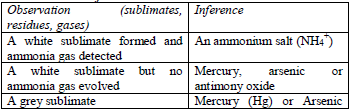
Different substances decompose on heating to give different products. Many compounds decompose on heating and leave solid residues. In performing this test, the compound is heated in an ignition tube or dry test tube. Heating is continued until no further change occurs. The gas evolved, residue left or sublimate formed on heating may help to identify the acid radical present in a compound.
Table 5.5 Action of heat on the test substance
g1_1449517475730
g2_1449517487093
Action of dilute sulphuric acid or dilute hydrochloric acid
Treat the solid with cold dilute sulphuric or hydrochloric acid. Identify the gas evolved. If there is no reaction with the cold acid, heat the mixture gently. Heat carefully and ensure the mixture does not boil. The gas evolved can be identified as follows:
Table 5.6 Detection of acidic radicals
g1_1449518076868
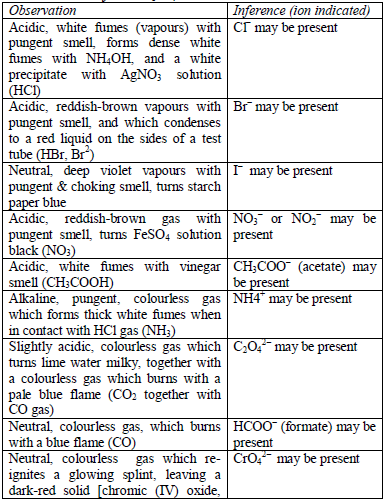
Action of concentrated sulphuric acid
As in the above test, the acid is added to the solid substance and if no reaction occurs, the mixture is warmed gently, but the mixture should not be boiled. Then, the gas given off is identified. In addition, observe any product, other than the gas, which results from the reaction.
Table 5.7 Action of conc. H2SO4
g1_1449522719399
g2_1449522733689
Note:
  • Oxalates give CO2 with concentrated H2SO4 but not with. HCl.
  • Nitrates do not give NO2 when treated with HCl but nitrites give NO2 gas.
  • If no result is obtained in the above tests, the salt is probably a sulphate, chromate or phosphate.
Cations and Anions Identifie
Confirm cations and anions identified
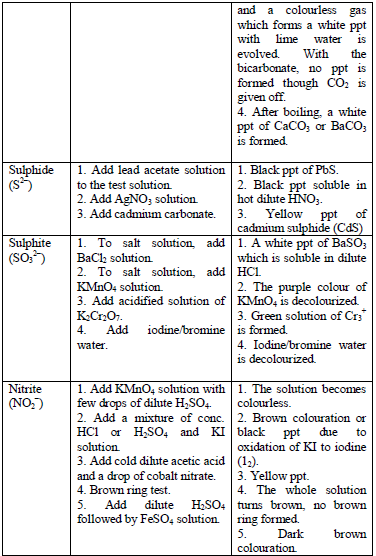
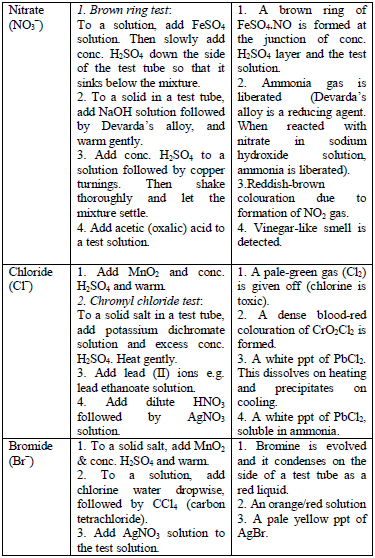
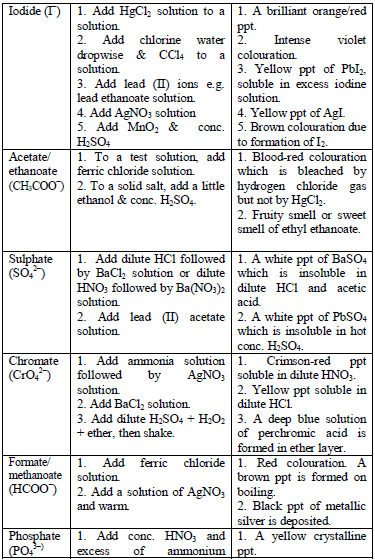
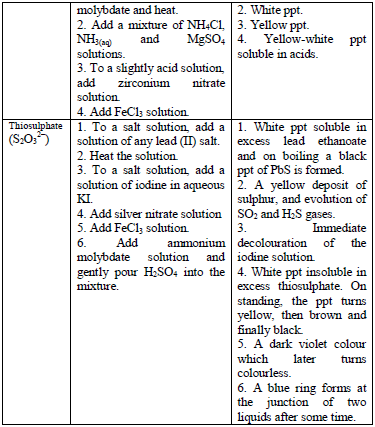
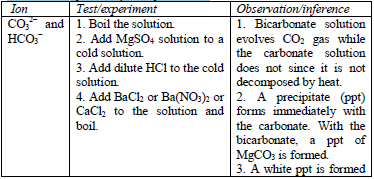
The detection of acidic radicals is important in that, in addition to other information, it enables a clear-cut identification of the substance being analysed. The substances are first dissolved in distilled water to make solutions. Then, the resulting solutions are tested for radicals. Table 5.8 shows a list of test/experiments, each of which confirms the presence of a given ion. Depending on the availability of reagents, students can do any of the listed tests to confirm the ions present in test solutions.
Table 5.8 confirmatory tests for anions
g1_1449523752118
g2_1449523836305
g3_1449523896447
g6_1449524214504
g5_1449524004151
TESTS FOR METALLIC RADICALS
Flame test
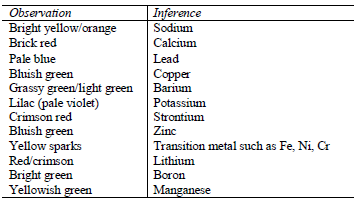
Some metal ions can be identified by the colour of their flame during a flame test. Flame test involves mixing solutions of ions with conc. HCl and then heating them on a platinum or nichrome wire over a non luminous flame. Alternatively, a dry solid can be used instead of the solution.To perform this experiment, dip a platinum or nichrome wire into concentrated hydrochloric acid and hold it just above the blue part of the flame. Repeat the process until the wire is clean. After that dip the clean wire into the acid and the dip it into the solution of the test substance (or its solid particles). Heat the substance strongly and observe the colour of the flame formed.
The flame changes to a colour characteristics of the element. The following are characteristic flame colours of some metal ions.
g1_1449524657435
Action of hydrochloric acid
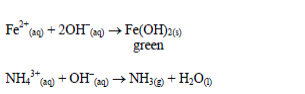
Add dilute hydrochloric acid dropwise to the test solution until the solution tests acidic to litmus paper. Observe for any reaction. A precipitate will form with any cation that forms an insoluble chloride. For example:

g1_1449524846691
This can then be subjected to further tests to confirm the specific cation present in the solution.
Action of sulphuric acid
Add dilute sulphuric acid dropwise to the test solution until the solution is acidic. Observe for any reaction. A precipitate will form with any cation that forms an insoluble sulphate. For example:
g1_1449525216841
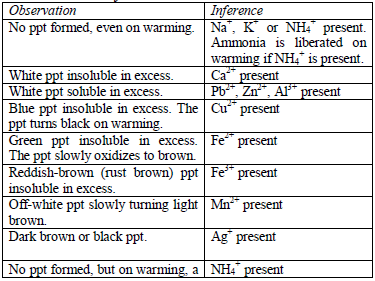
Action of sodium hydroxide
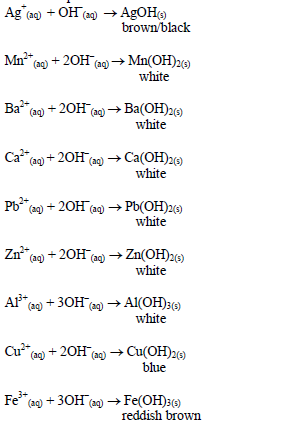
Add sodium hydroxide solution, a little at a time, to the test solution until there is an excess of it. Stir or shake the mixture and observe for any reaction. If no precipitate is formed, warm the mixture gently and test for ammonia. If a precipitate forms, continue adding the sodium hydroxide solution.
Table 5.9 Reaction of cations with dilute NaOH
g1_1449525973914
g2_1449525984673
Reaction equations:
g1_1449526350961
g2_1449526364088
The oxides of zinc, aluminium and lead are soluble in excess sodium hydroxide. This is due to the amphoteric nature of the hydroxides of these metals.
g1_1449526613030
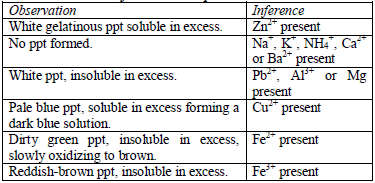
Action of aqueous ammonia
Add dilute aqueous ammonia to the test solution, drop by drop. Stir or shake the mixture and observe for any reaction. If a ppt forms, continue adding aqueous ammonia.
Table 5.10 Reaction of cations with aqueous ammonia
g1_1449527142583
g2_1449527151519
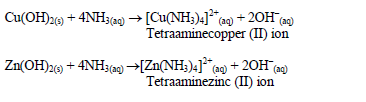
An excess of aqueous ammonia dissolves the hydroxides of copper and zinc forming complex compounds of the metals:
g1_1449527434747
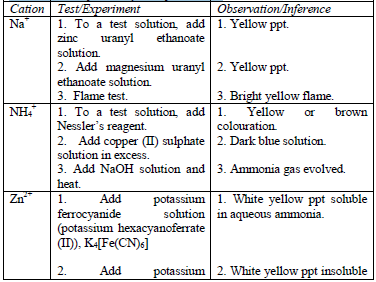
Confirmatory tests for cations
After the preliminary tests have been performed, there is always a need to carry out confirmatory tests to confirm the presence of cations in substances.
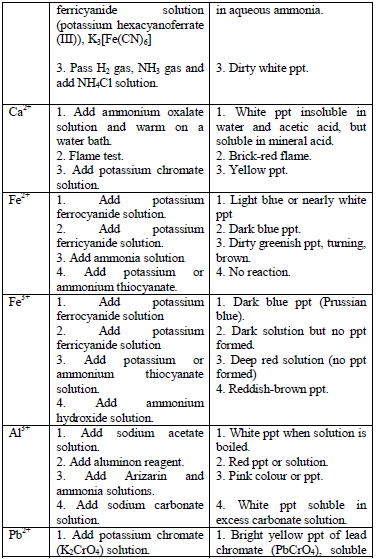
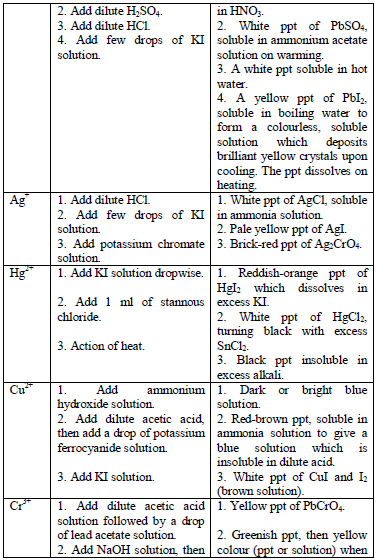
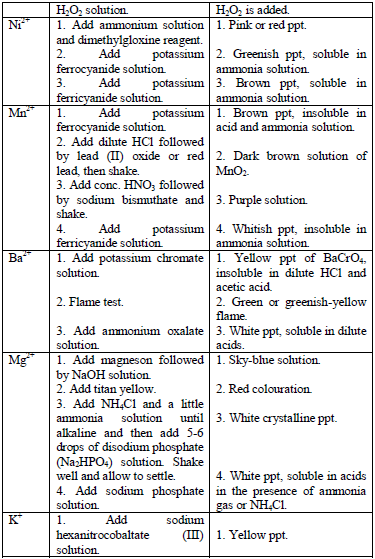
Table 5.11 Confirmatory tests for cations
g1_1449528694584
g2_1449528710929
g1_1449529366328
g4_1449528740016
g5_1449528750732
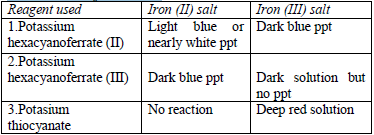
Confirmatory tests for iron salts
The original test solution has to be divided into three portions. Then the solutions should be treated with the following reagents and the results recorded as shown in table 5.12.
  1. Potassium hexacyanoferrate (II) solution
  2. Potassium hexacyanoferrate (III) solution
  3. Potassium thiocyanate solution
Table 5.12 Tests for iron salts
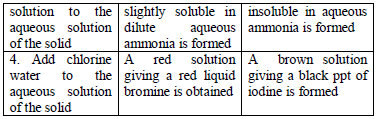
g1_1449530704484
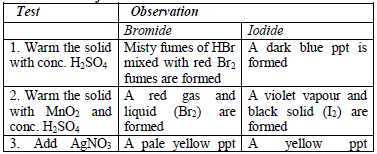
Table 5.13 Tests for bromides and iodides
g2_1449531292996
g3_1449531298173
Write-up of analytical data
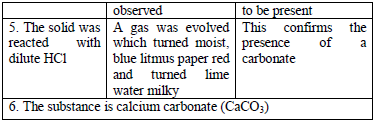
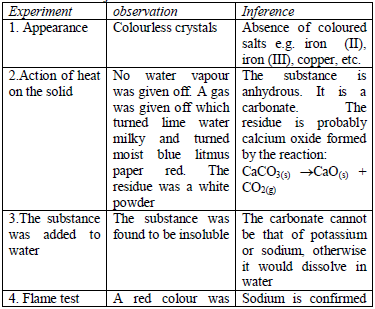
All the observations made and any experimental data obtained during the experiment (or test) must be presented in a tabular form a shown below. Results presented in a table are concise, easy to read and understand. The last column of the table gives the conclusions based on the observations made.
Table 5.14 Table of results
g4_1449532143242
g5_1449532145385